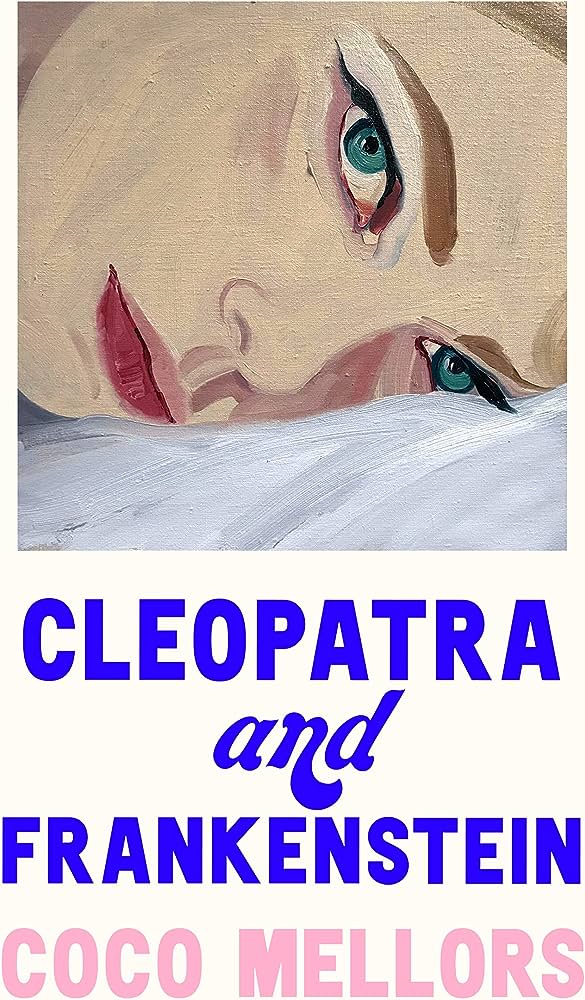
“New York is slipping from Cleo’s grasp. Sure, she’s at a different party every other night, but she barely knows anyone. Her student visa is running out, and she doesn’t even have money for cigarettes. But then she meets Frank. Twenty years older, Frank’s life is full of all the success and excess that Cleo’s lacks. He offers her the chance to be happy, the freedom to paint, and the opportunity to apply for a green card. She offers him a life imbued with beauty and art -and, hopefully, a reason to cut back on his drinking.”
Whilst Cleopatra and Frankenstein expertly illustrates the familiar longing for and resentment of youth, wealth, love and belonging, the teaching that Mellors truly leaves us with is one of self-discovery. By following Cleo’s journey throughout the novel, one can’t help but recall the familiar urge to gain meaning and identity through the eyes of others, whilst serving as a harsh reminder of the futility of such endeavours.
At their hurried courthouse wedding, the words Frank chooses to usher in the couple’s new chapter are, “when the darkest part of you meets the darkest part of me, it creates light”. Instead of light, however, their catastrophic marriage led to the evisceration of both characters, taking the readers’ initial perception of them from the beautiful to the damned, depraved, and empty.
Cleo, an ethereal beauty, is surrounded by love and admiration. She is placed on a pedestal by all that she seems incapable of climbing off, no matter how far she seems to fall. She is profoundly lonely, between her best friend Quentin, unable or unwilling to see her clearly as he grapples with his own sexual identity, and her husband Frank who, riddled with self-hatred under a veneer of charm and excess, believes her to be the antithesis of his debasement.
The reader is privy to Cleo’s internal thoughts and actions, a luxury which is bestowed on neither Frank nor Quentin. Their woeful misalignment with Cleo is crystallised by comments such as Quentin’s lofty proclamation that “we are not those kinds of people”, when Cleo expresses a wistful longing for a cosy family life, or Frank’s remark that whilst Cleo is golden, he is not. This comment comes after the breakdown of their marriage, after Cleo’s affair with his best friend Anders, after Cleo’s suicide attempt, and after the pointed cruelty she showed by exclaiming that it was Frank that had pushed her to suicide, instead of acknowledging that depression and loss of identity are spirals that nobody else can pull you out of – try as they might.
For both characters, meeting Cleo where she was, in all of her despair, would have required them to come to terms with the aspects of themselves that they would much rather avoid. Frank’s alcoholism, and the chaos that lay in it’s wake, and Quentin’s gender dysphoria which led to his deeply destructive relationship with the meth-addled Alex, kept both characters firmly cemented in their own worlds with little time for a deeper understanding of Cleo. Whatever the cause, the darkest part of Cleo meeting the darkest part of Frank led only to anguish, obscurity and self-loss.
The path that ultimately led to light was the meeting between the characters and the darkest parts of their own being. At the end of the novel, the art Cleo finally goes on to create in Rome is not objectively good. It is not fit for commercial purposes, and makes very little sense to Frank. The good part? Frank’s lack of approval means little to Cleo, a notion as surprising to the character as it is to the reader. Through her pain and in her solitude, Cleo has gone from someone who is at first stunningly referred to as “a vase of Lillies tipped over” – the perfect image of delicacy, femininity and instability – to someone who makes bold art, that is deeply introspective and unabashed. She has become someone who is able to understand the complex nature of her inner world and has found a way of expressing it in a way that is both authentic and resolute. She has finally learned to live from the inside out, and in doing so, has also found peace.
Shadow work psychology has gained significant popularity in recent years, as more and more individuals seek to embark on a journey of self-discovery and personal growth. Drawing upon the teachings of renowned psychologist Carl Jung, shadow work invites individuals to explore the often hidden and repressed aspects of their identity, known as the “shadow self.”
The concept of the shadow self refers to those traits, desires, and emotions that we consciously or unconsciously deem unacceptable or incompatible with our desired self-image. These aspects are often pushed to the depths of our psyche, where they reside as unprocessed emotional baggage. However, embracing and integrating these shadow elements can lead to profound healing and self-realization.
Engaging in shadow work requires courage and vulnerability. It involves delving into the depths of our being, confronting our fears, insecurities, and unresolved traumas. By acknowledging and accepting these darker aspects, we open the door to self-compassion, self-understanding, and ultimately, self-empowerment.
Cleopatra and Frankenstein shows us that it is only by embracing our shadow that we are able to break free from societal expectations and the limitations imposed by others. It is only when we truly know and accept ourselves, in all our complexity and multidimensionality, that we can make decisions and take actions that align with our authentic selves. By embracing our shadow, we unlock our true potential and pave the way for personal growth, transformation, and inner harmony. As cliche as it may be, perhaps the key to our happiness truly is within…

 VERSIVE